
St. Rita
#MOB 42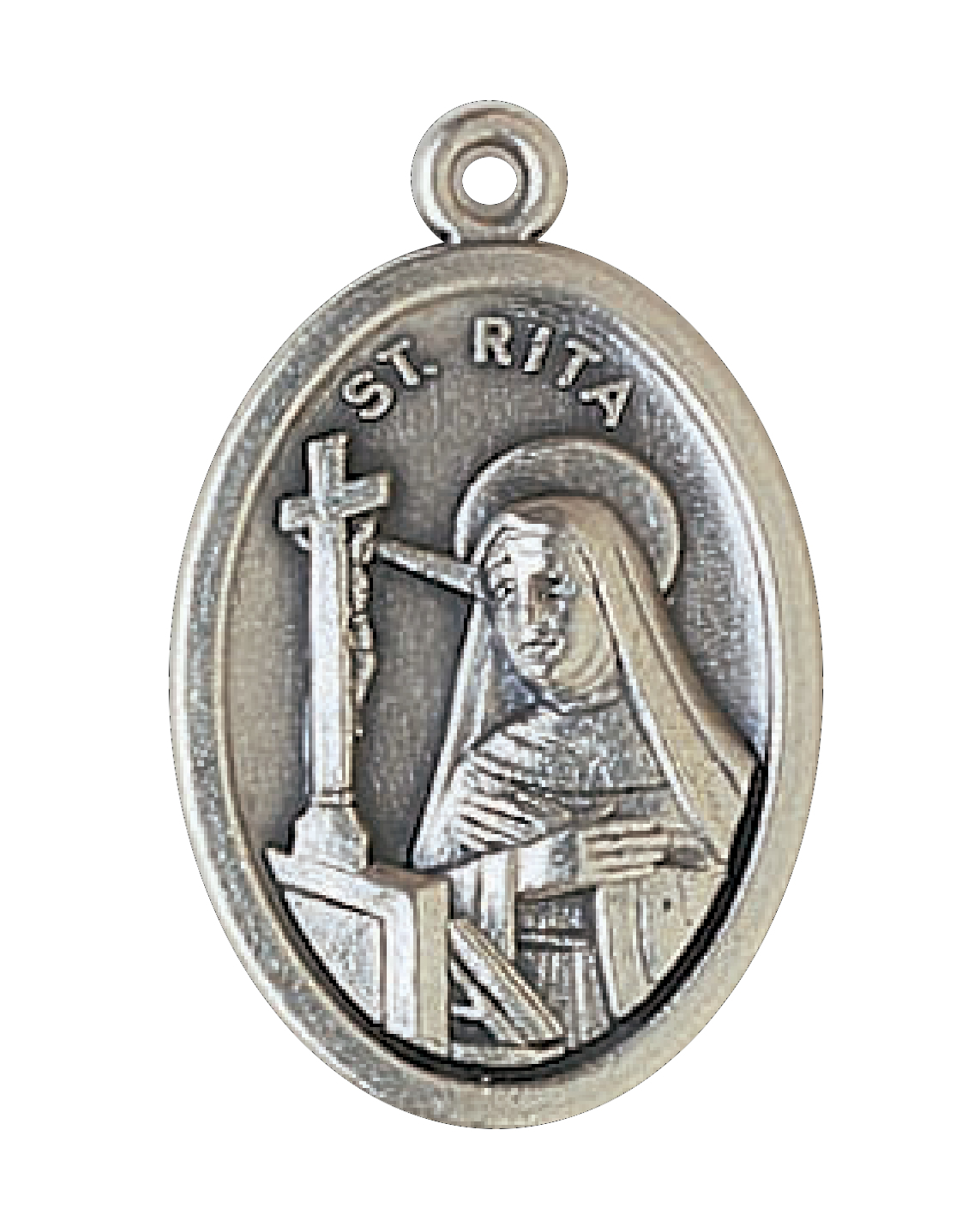
MOB 42 St. Rita
Margherita Lotti was born in 1381 in the city of Roccaporena, a small suburb of Cascia (near Spoleto, Umbria, Italy) where various sites connected with her are the focus of pilgrimages. Her name, Margherita, means “pearl”. She was affectionately called Rita, the short form of her baptismal name. Her parents, Antonio and Amata Ferri Lotti, were known to be noble, charitable persons, who gained the epithet Conciliatori di Cristo (English: Peacemakers of Christ). According to pious accounts, Rita was originally pursued by a notary named Gubbio but she resisted his offer. She was married at age twelve to a nobleman named Paolo Mancini. Her parents arranged her marriage, a common practice at the time, despite her repeated requests to be allowed to enter a convent of religious sisters. Her husband, Paolo Mancini, was known to be a rich, quick-tempered, immoral man, who had many enemies in the region of Cascia. The marriage lasted for eighteen years, during which she is remembered for her Christian values as a model wife and mother who made efforts to convert her husband from his abusive behavior.
Rita endured his insults, physical abuse and infidelities for many years. According to popular tales, through humility, kindness and patience, Rita was able to convert her husband into a better person, more specifically renouncing a family feud known at the time as La Vendetta. Rita eventually bore two sons, Giangiacomo (Giovanni) Antonio and Paulo Maria, and brought them up in the Christian faith. As time went by and the family feud between the Chiqui and Mancini families became more intense, Paolo Mancini became congenial, but his allies betrayed him and he was violently stabbed to death by Guido Chiqui, a member of the feuding family.
Rita gave a public pardon at Paolo’s funeral to her husband’s murderers. Paolo Mancini’s brother, Bernardo, was said to have continued the feud and hoped to convince Rita’s sons to seek revenge. Bernardo convinced Rita’s sons to leave their manor and live at the Mancini villa ancestral home. As her sons grew, their characters began to change as Bernardo became their tutor. Rita’s sons wished to avenge their father’s murder. Rita, fearing that her sons would lose their souls, tried to dissuade them from retaliating, but to no avail. She asked God to remove her sons from the cycle of vendettas and prevent mortal sin and murder. Her sons died of dysentery a year later, which pious Catholics believe was God’s answer to her prayer, taking them by natural death rather than risk them committing a mortal sin punishable by Hell.
After the deaths of her husband and sons, Rita desired to enter the monastery of Saint Mary Magdalene in Cascia, but was turned away. Although the convent acknowledged Rita’s good character and piety, the nuns were afraid of being associated with her due to the scandal of her husband’s violent death and because she was not a virgin. However, Rita persisted in her cause and was given a condition before the convent could accept her: the task of reconciling her family with her husband’s murderers. She implored her three patron saints (John the Baptist, Augustine of Hippo, and Nicholas of Tolentino) to assist her, and she set about the task of establishing peace between the hostile parties of Cascia. Popular religious tales recall that the bubonic plague, which ravaged Italy at the time, infected Bernardo Mancini, causing him to relinquish his desire to feud any longer with the Chiqui family. She was able to resolve the conflicts between the families and, at the age of thirty-six, was allowed to enter the monastery.
Pious Catholic legends later recount that Rita was transported into the monastery of Saint Magdalene via levitation at night into the garden courtyard by her three patron saints. She remained at the monastery, living by the Augustinian Rule, until her death from tuberculosis on 22 May 1457.

Back Side

05
